@Cindy Preta Is there any chance you could lift the veil a little and share some details about the setup you use? I feel like I'm clicking pretty quickly, and I could probably squeeze out a few more points with some improvements, but your results seem completely out of my reach. What's the secret?
When I started competing again a few weeks ago, I felt fast, but it took several weeks of training to minimize my reaction time. I haven't fully regained all my capabilities yet, but I'm gradually getting there. So there is no secret, no luck, only training.
Hello everyone, I'd like to ask for your advice. I'm having trouble improving my performance when playing Delay Control. I have absolutely no idea how to distinguish between delays of 5ms and 90ms. I can't grasp the timing or the characteristics of the differences in sound spread.
I can understand the difference in attack time when using compressor control, but I can't distinguish it at all with Delay Control. How do you all distinguish between them? Also, are there any training methods to help me perceive those differences? I want to develop a precise sense of timing. Any advice would be greatly appreciated.
Have you tried using the training mode on the game? You can literally set the delay you want to hear and move the slider that changes delay in order to hear the differences. I still find it hard to distinguish between 1 msec and 10 msec delays, but anything over 40 msec can actually be heard as a separate tone. Even below 40 msec, the amount of smearing of the sound is distinguishable and with enough comparison using the training mode, you will begin to become somewhat accurate.
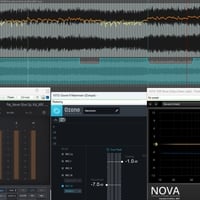
An additional thing to note is that at short delays (say 15 msec), you'll be hearing a lot of comb filtering with associated frequency shifts. I did an interesting experiment with these short delays a couple of years ago to verify that yes, I really was hearing frequency shifts for short delays in this game. Put a pink noise generator on a track in your DAW, followed by a delay plugin, followed by a spectrum analyzer. You'll visually see the comb filtering and how it shifts as you vary the delay time. And you really can hear the frequency shifts as well - this is how I approach delays of 20 msec or so. I've attached a screen shot of the comb filtering for a 3 msec delay as an example. Good luck!
Thank you all so much for providing so many helpful opinions.
@Lee Li There is indeed a change in sound pressure or volume. Perhaps my listening awareness was insufficient. I will check again. Thank you for your valuable feedback.
@Romano G Thank you very much for providing the link. I couldn't find any past articles like this myself, so it was very helpful. The general sense of delay and shortcut commands will be useful for future planning. Thank you very much.
@Billy Mohney I haven't always prioritized delay in practice. The real goal isn't just game scores, but improving the quality of my projects, right? I want to continue experimenting and practicing not only in games but also in real projects, reflecting those experiences in my work, with the ideal scenario being an improvement in both my perception and my scores. Thank you very much for your feedback.
@Mike Booth Thank you very much for your thoughtful advice, taking into account that people perceive and distinguish sounds differently. Sound Gym's questions sometimes ask for incredibly precise differences, don't they? I will do my best to be able to perceive at least a basic short delay based on the advice I received. Thank you very much for your valuable feedback.
@Linda Wagner I completely overlooked the training mode. I'm embarrassed that I didn't notice it when I was trying to solve the problem. After trying it out a bit, I felt that the attack component was more clearly audible with the piano than with the acoustic guitar. For the time being, I'll focus on developing my sense of sound with the piano, where the delay is easier to perceive. Thank you very much for your advice.
@Steve Rinaldi So that phenomenon exists!? I'm surprised to learn the true nature of the strange feeling I've had when working with short delays. I knew that sounds interfere with and cancel each other out, but I had no idea that it would also affect delay sounds. I think it's wonderful that you've noticed this, experimented, recorded your findings, and are working to improve your skills. I will also try to improve my own skills, though I am still far from being able to do so. Thank you very much for sharing your valuable experimental results and advice.
I usually work on my projects and studies alone, so receiving so much warm and helpful advice from everyone has given me a glimmer of hope, like being rescued from adrift. I will cherish your advice and strive to improve my listening and mixing skills.😃
select the playlist on your youtube channel. You'll see a share option. Click and it will give an option to copy. Open SoundGym, paste in the What's on you mind window.
We use cookies to improve your experience. Essential cookies keep the site running. We also use optional cookies to enhance performance, analyze traffic, and personalize ads. By clicking “Accept”, you agree to the use of all cookies.

Jul 06, 20:18
Jul 06, 21:37